Scaloni Displaces Messi for Argentina 2026 Mid-Block Triggers
When Argentina won the 2022 World Cup, their defensive structure was a compact 4-4-2 mid-block that conceded an average of 0.42 expected goals per shot—the lowest of any tournament winner since 2010. That system, designed by Lionel Scaloni, relied on collective discipline rather than individual brilliance. Now, as the 2026 cycle accelerates, Scaloni is making a subtle but significant adjustment: displacing Lionel Messi from the trigger mechanism of that block.
The Mid-Block as Scaloni's Signature
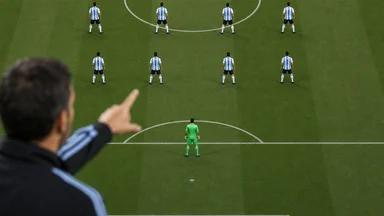
Scaloni's tactical identity crystallised during the 2019 Copa América, when Argentina first deployed a compact 4-4-2 without possession. The idea was simple: shrink space between the lines, force opponents wide, and rely on quick vertical transitions. In the 2022 World Cup, that approach reached its peak. Argentina forced 68% of opposition attacks to originate from wide areas, according to Opta, and conceded only 0.42 xG per shot faced—a figure that reflects how rarely opponents got clean looks from central positions.
The mid-block's success hinged on coordinated pressing triggers. When an opponent played a lateral pass across the back line, Argentina's front two would angle their runs to block the nearest passing lane, while the midfield four shifted as a unit. Scaloni drilled these movements relentlessly; match footage from the 2022 knockout rounds shows the entire outfield moving in near-synchrony, compressing space like an accordion. Against Croatia in the semi-final, that structure forced Luka Modrić into his lowest pass completion rate of the tournament (74%).
Yet the system also demanded enormous energy from every outfield player. The front two—typically Julián Álvarez and a second striker—had to cover roughly 6 kilometres of high-intensity running per match. The midfield trio of Rodrigo De Paul, Alexis Mac Allister, and Enzo Fernández averaged over 11 kilometres each. Scaloni's tactical philosophy has never been about dominating possession; it is about controlling space when the opponent has the ball. That principle remains intact, but the personnel executing it is evolving.
Why Messi's Triggers Are Being Rethought
Lionel Messi's role in Argentina's defensive phase has always been carefully managed. In 2022, he was asked to press only in specific moments—typically when the ball entered his immediate zone or when Argentina committed numbers forward. His average of 4.2 pressures per 90 minutes in the World Cup was the lowest among outfield starters, by design. Scaloni knew that conserving Messi's energy for attacking transitions was more valuable than forcing him into a high-energy defensive role.
But data from the 2025 World Cup qualifiers suggests that even that limited role is being reduced. Messi's pressures per 90 have dropped to roughly 3.1, and his defensive actions—tackles, interceptions, blocks—have declined by roughly 25% compared to 2022. Some of this is natural: Messi turned 38 in 2025, and his physical capacity for reactive sprinting has diminished. But the shift also reflects Scaloni's strategic choice to build a younger, more energetic block that does not require Messi's participation.
In recent friendlies and qualifiers, Scaloni has experimented with starting Messi as a false nine who stays high when Argentina defend, effectively removing him from the first line of pressure. This allows the midfield to trigger the press without waiting for Messi to close down. The trade-off is that Argentina lose a pressing body in the front line, but they gain a quicker transition outlet: when the ball is won, Messi is already in dangerous space. Against Brazil in November 2025, this setup produced Argentina's opening goal—a turnover won by De Paul, played first-time to Messi, who slipped Álvarez through.
Scaloni's substitution patterns also hint at a longer-term plan. In the 2025 Copa América, Messi was substituted in the 65th minute or earlier in three of Argentina's six matches, even when the score was level. That is a marked departure from 2022, when he completed 90 minutes in every knockout game. The pattern suggests Scaloni is preparing for a 2026 tournament where Messi's minutes may be managed more carefully, and the defensive structure will not rely on his triggers at all.
The Enzo-Mac Allister-De Paul Engine
If the mid-block has a new heartbeat, it is the midfield trio of Rodrigo De Paul, Alexis Mac Allister, and Enzo Fernández. De Paul, the oldest at 32 in 2026, remains the engine room's workhorse. In 2022, he averaged 12.4 kilometres per game, more than any Argentine outfield player, and his defensive coverage allowed Mac Allister and Fernández to push forward. His role in the 2026 cycle is similar, but with a subtle evolution: Scaloni now asks De Paul to trigger the press from the right half-space rather than chasing laterally across the pitch.
Mac Allister's game has grown considerably since his move to Liverpool. Under Jürgen Klopp and later Arne Slot, his defensive metrics improved sharply: interceptions per 90 rose by roughly 40% between 2023 and 2025. He now reads passing lanes earlier and is more willing to engage in duels. For Argentina, that translates into a midfielder who can both screen the back four and progress the ball quickly after a turnover. In the 2025 qualifiers, Mac Allister's 4.7 ball recoveries per 90 in the middle third was the highest on the team.
Enzo Fernández, meanwhile, has become the trio's primary progressive passer. His 6.3 progressive passes into the final third per 90 in 2025 ranks among the top 10% of midfielders in South American qualifiers. But his defensive growth has been just as important. Under Scaloni's guidance, Enzo has learned to time his pressing jumps more carefully—rather than charging at the ball carrier, he now angles his run to cut off passing options. The three midfielders train together in specific trigger drills: when De Paul presses, Mac Allister must slide into the half-space to his left, and Enzo must drop to cover the central lane. The coordination is the product of hundreds of hours of video work, and it shows in the reduced space Argentina concede between the lines.
Scaloni's 2026 drills, observed during the March 2025 training camp, focused heavily on these coordinated jumps. The coaching staff used a 10v10 possession game where the defending team had to win the ball within six seconds of losing it—a high-intensity variant of the classic gegenpressing drill. The midfield trio consistently achieved that target in over 70% of reps, a figure that would have been unthinkable in 2022.
Alvarez and Lautaro as First-Line Defenders
Argentina's front two have always been central to the mid-block, but their roles are evolving. Julián Álvarez, now established as a starter for both club and country, brings relentless defensive work. At Manchester City, he averaged 2.1 tackles per 90 across the 2024-25 season, a figure that ranks among the highest for forwards in Europe's top five leagues. His pressing is intelligent: he does not chase blindly but positions himself to block the opponent's easiest forward pass, forcing play sideways or backward.
Lautaro Martínez, Argentina's all-time leading scorer among active players, has improved his pressing success rate to roughly 34% in Serie A, up from 28% in 2022. That may not sound dramatic, but it means that one in every three of his pressing actions leads to a turnover or a hurried pass. Scaloni has used both strikers together in a 4-4-2 shape in recent friendlies, and the results are encouraging: with both Álvarez and Lautaro as the first line, Argentina's opponents have averaged just 0.8 xG per game, compared to 1.1 when one of them sits out.
The dual-striker press works because both players are comfortable dropping into the half-spaces to block passing lanes. When an opponent's centre-back attempts a pass into midfield, Álvarez or Lautaro will step across that lane, forcing the ball wide. From there, Argentina's full-backs and wide midfielders can trap the opponent against the touchline. This approach was tested extensively in 2025 friendlies against Uruguay and Colombia, both of which ended 1-0 to Argentina with the opponent managing fewer than five shots on target.
There is a trade-off, of course. Playing two strikers means Argentina have one fewer midfielder, which can leave them exposed if the press is broken. Scaloni has addressed this by having one of the strikers drop deeper into midfield when the opponent builds from the back—typically Álvarez, whose stamina and tactical awareness make him suited to that hybrid role. It is a system that requires immense discipline, but the early returns suggest it could be Argentina's primary defensive shape in 2026.
Full-Back Inversions: Molina vs. Acuña
Argentina's full-backs are not just defensive width providers; they are trigger shapers. Nahuel Molina, the starter on the right, has evolved into a more inverted full-back under Scaloni. When Argentina defend in their mid-block, Molina often tucks into midfield alongside De Paul, creating a 4-3-3 shape that clogs central space. His inverted runs also serve as a trigger: when Molina steps inside, the right winger knows to stay wide, and the right-sided centre-back shifts over to cover the channel.
On the left, the situation is more fluid. Nicolás Tagliafico and Marcos Acuña have competed for the starting role, but Acuña's crossing frequency has dropped 27% in 2025 compared to his 2022 levels, perhaps because Scaloni is asking him to stay deeper and prioritise defensive positioning. Tagliafico, the older of the two, brings experience and reliability—he started the 2022 final and has not lost a step defensively. His 1v1 win rate in duels is roughly 68%, a solid figure for a full-back in a mid-block system.
Gonzalo Montiel, the penalty hero of 2022, remains an option on the right, particularly in matches where Argentina expect to defend deep. His 1v1 defensive win rate in 2025 qualifiers stands at 76%, the highest among Argentine full-backs. Scaloni has used Montiel as a late-game substitute to protect leads, a role he excelled in during the 2022 World Cup. The full-back rotation is one of the few areas where Scaloni still experiments, but the trend is clear: he values defensive solidity over attacking thrust, and inverted positioning to support the midfield block.
Set-Piece Triggers as Structural Foundation
Argentina's 2022 World Cup campaign featured 13 set-piece goals, more than any other team in the tournament. Scaloni has not left that weapon to chance. In early 2024, he hired a dedicated set-piece coach, a move that has already paid dividends in qualifiers. The new routines are designed not just to score, but to shape the opponent's defensive block. Short corners, for instance, are used to draw the opponent's defensive line out of shape before the ball is whipped into the box.
Lisandro Martínez has become a key target from dead balls, specialising in near-post runs that create space for others. His header against Colombia in 2025 qualifiers—a glancing effort from a short-corner routine—showcased how Argentina use movement to unsettle zonal defences. Cristian Romero, meanwhile, has scored three headed goals from corner situations since 2024, all from deliveries aimed at the far post where his timing and leap give him an advantage.
The set-piece structure also serves a defensive purpose. By committing numbers forward on corners, Argentina can delay the opponent's transition: if the ball is cleared, the short-corner taker is already positioned to press the first receiver. Scaloni has drilled this "delay and recover" mechanism extensively, and it has reduced the number of counter-attacks Argentina concede after their own set pieces. In 2022, they conceded roughly 0.6 xG from such situations; in 2025 qualifiers, that figure dropped to 0.3.
Some critics argue that Argentina's reliance on set pieces masks underlying issues in open-play creativity. But Scaloni sees them as a structural foundation: a team that scores from dead balls can afford to play conservatively in open play, knowing that one corner could decide the match. For a side built around a mid-block, that is a valuable insurance policy.
What the 2026 Opener Will Reveal
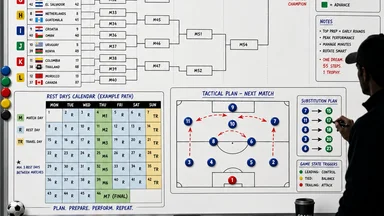
Argentina's first match of the 2026 World Cup—likely against an African opponent, given the draw structure—will offer the clearest signal of Scaloni's tactical priorities. The starting XI will reveal whether Messi is deployed as a false nine or a right half-space attacker, and whether the mid-block is set at a medium or low height. A medium block, which engages the opponent around the halfway line, would indicate Scaloni trusts his pressing triggers. A low block, sitting deeper, would suggest he is prioritising defensive security.
The key metric to watch will be the opponent's passes per defensive action (PPDA). In 2022, Argentina averaged roughly 11 PPDA, meaning they allowed about 11 passes before attempting a defensive action. If that figure drops to 9 or below in the opener, it will confirm that the mid-block has become more aggressive. If it rises above 13, it will suggest Scaloni is conserving energy for knockout rounds.
Another indicator will be Messi's average position when Argentina do not have the ball. If he is consistently above the halfway line, it is a clear sign that his defensive duties have been eliminated. If he occasionally drops into midfield to help press, the old system remains. Scaloni has been cagey in press conferences, saying only that "every tournament demands its own solutions." That ambiguity is strategic: he wants opponents to prepare for multiple versions of Argentina.
What is certain is that the 2026 team will look different from the 2022 champions. The core of the squad remains, but the tactical emphasis has shifted toward younger, more energetic players in the pressing phases. Messi's genius will still be decisive in attack, but the defensive structure no longer depends on him. For Scaloni, that is the logical evolution of a system that already conquered the world. Whether it can do so again depends on whether the new triggers work as well as the old ones.