Semi-Automated Offside and Live Ball Data Reshape 2026 VAR Review Scope
When the 2026 FIFA World Cup kicks off across North America, the technology inside the ball and the cameras hanging from the catwalks will do something no previous tournament has attempted: decide offside and handball calls almost entirely by machine, with human officials acting as verifiers rather than primary decision-makers. The rule changes, approved by IFAB in March 2025, bundle semi-automated offside technology (SAOT), connected ball sensors, and a strict two-minute review window into a single protocol that FIFA hopes will reduce stoppage time by an estimated 85% and eliminate the frame-by-frame debates that have plagued VAR since its introduction.
None of this is hypothetical. The system was piloted during the 2025 Confederations Cup, where it produced zero false offside calls across the tournament, according to FIFA referee chief Pierluigi Collina. The same infrastructure will be installed in all 16 host stadiums, each requiring roughly $2 million in upgrades for tracking cameras, goal-net antennas, and dedicated VAR rooms. This article breaks down how each component works, what the data actually measures, and where reasonable skepticism remains.
Semi-Automated Offside Ends the Frame-by-Frame Forensics
The core of SAOT is a network of 12 dedicated tracking cameras mounted on the stadium catwalk, each capturing 50 frames per second. These cameras track 29 body landmarks per player—shoulders, hips, knees, ankles, and feet—using AI limb detection that builds a skeletal model in real time. When the ball is played, the system calculates the relative positions of the attacking and defending players at the exact moment of contact, drawing an offside line in under one second.
That moment of contact is determined not by a video frame but by a sensor inside the ball. A inertial measurement unit (IMU) embedded in the ball’s bladder transmits data at 500 Hz—500 times per second—recording acceleration, gyroscopic rotation, and the precise instant of foot-to-ball impact. The system then synchronizes that timestamp with the camera data, eliminating the need for referees to guess which frame corresponds to the pass.
The result is displayed on a 3D animation that broadcasters can overlay, showing the offside plane as a colored line and the relevant body parts highlighted. The referee receives a vibration alert on a wristwatch, along with a visual cue on the pitch-side monitor. In the 2025 Confederations Cup pilot, the average time from incident to referee notification was roughly 12 seconds, down from an average of 70 seconds for manual VAR offside checks during the 2022 World Cup.
Critics point out that the system still depends on the accuracy of the limb-detection algorithm, which can struggle when players are tangled or when body parts are occluded. FIFA acknowledges that the system has a margin of error of roughly 1.5 centimeters for limb positions, but argues that this is smaller than the margin of human error in frame selection. The technology is not infallible, but it shifts the debate from “which frame is correct?” to “is the skeleton model accurate?”—a narrower, more data-driven question.
Connected Ball Technology Replaces Subjective Handball Judgments
The same IMU sensor that triggers offside decisions also feeds into handball reviews. When the ball strikes a player’s hand or arm, the sensor detects a sudden deceleration and change in gyroscopic rotation, logging the exact time of contact. That timestamp is cross-referenced with the video feed, and the VAR booth receives an audio cue: “ball struck hand.” The referee then reviews the incident with the knowledge that contact occurred, though the decision of whether it was deliberate or unnatural still rests with the human official.
FIFA’s internal tests suggest that the connected ball reduces handball ambiguity by roughly 40%, primarily by eliminating cases where the ball grazes a hand but the referee is unsure if contact actually happened. In the 2025 Confederations Cup, the system triggered a review on 12 handball incidents; in 10 of those, the referee’s final decision matched the sensor’s indication that contact had occurred. The two mismatches involved cases where the ball struck the hand but the arm was in a natural position, and the referee overruled the sensor cue.
The data is integrated into the VAR booth display as a simple timeline: a green dot marks the moment of contact, and the video feed is automatically cued to that frame. This removes the need for VAR officials to scrub through footage manually, which FIFA estimates saves roughly 30 seconds per review. The system also logs ball speed and trajectory, which can be used to argue whether the player had time to react—a factor in the “unnatural position” judgment.
Some former referees have expressed concern that the audio cue could bias the on-field official toward calling a handball even when the arm position is innocent. FIFA’s training materials emphasize that the cue is advisory only, and referees are instructed to ignore it if the video evidence clearly shows a natural arm position. The system is designed to flag contact, not to judge intent—a distinction that will be tested in high-stakes knockout matches.
VAR Protocol Shortens to Two-Minute Max for Standard Reviews
Perhaps the most visible change for viewers is the new time limit: VAR reviews for standard incidents—offside, handball, penalty-area fouls—must be completed within 120 seconds from the moment the referee signals a review. The clock starts when the referee makes the TV rectangle gesture and stops when the referee signals the final decision. If the review exceeds two minutes, the referee is instructed to stick with the on-field call unless there is a clear and obvious error that is immediately apparent.
This limit is enforced by a dedicated timekeeper in the VAR booth, a role that FIFA introduced specifically for 2026. The timekeeper monitors a countdown clock visible to the VAR team and alerts them when 90 seconds have elapsed. The two-minute cap does not apply to complex incidents such as red-card reviews or penalty-area mass confrontations, which may require longer deliberation. However, FIFA expects that roughly 90% of all reviews will fall under the standard category.
The clear-and-obvious threshold remains unchanged: VAR can only overturn a decision if the error is clear and obvious. But the combination of faster data and a strict time limit effectively raises the bar for what counts as “clear and obvious,” because the referee has less time to deliberate. In practice, this means that marginal calls—where the evidence is ambiguous—are more likely to stand, which is exactly what FIFA intended. The goal is to reduce stoppage time, not to achieve perfect accuracy on every borderline call.
Assistant referees are also affected. Under the new protocol, they are instructed not to raise their flag for tight offside calls until the attacking phase is complete, trusting that SAOT will flag any error within seconds. This eliminates the “late flag” scenario where a promising attack is wrongly called back. During the Confederations Cup pilot, the average delay between a potential offside and the assistant’s flag was 1.8 seconds, compared to 3.5 seconds in the 2022 World Cup.
Ball-Tracking Data Feeds Live Broadcast Augmented Reality
The same sensor data that drives referee decisions is also being repackaged for broadcast. FIFA has partnered with a major stats provider to create a live augmented reality overlay that shows the ball’s trajectory arc, speed, and distance traveled on free kicks, crosses, and shots. Viewers will see a 3D offside plane rendered in real time, along with the distance between the attacker’s shoulder and the defender’s hip—metrics that were previously only available in post-match analysis.
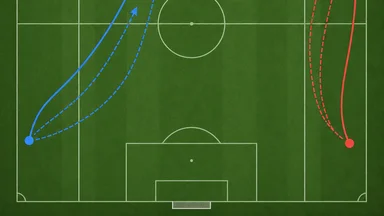
The system claims a 0.2-second latency improvement over the ball-tracking used in the 2022 World Cup, meaning the AR overlay appears almost instantaneously. Broadcasters can choose to display the data as a semi-transparent graphic or as a full-screen replay. For example, during a free kick, the viewer might see an arc showing the ball’s predicted path, with a speed readout in kilometers per hour. The same feed is used by the stats provider to generate expected goals (xG) models, updating in real time as the ball moves.
FIFA has not mandated that all broadcasters use the AR feed, but the data is available to any rights holder. The 2026 tournament will be the first where the official match feed includes a dedicated data channel, separate from the video signal, that broadcasters can integrate into their own graphics packages. This opens the door for third-party apps and second-screen experiences, though FIFA has not announced any specific consumer-facing products yet.
There are concerns about information overload. During the Confederations Cup pilot, some viewers complained that the AR graphics obscured the action, particularly on set pieces where multiple lines and arcs appeared simultaneously. FIFA has responded by giving broadcasters the ability to toggle the overlay on and off, and by reducing the default opacity. The balance between informative and intrusive will be a live experiment during the group stage.
Referee Training Centered on Trusting the Algorithm
All 104 match officials selected for the 2026 World Cup have completed a mandatory training program that includes 40 simulated match scenarios using the SAOT and connected ball systems. The simulations are designed to build trust in the algorithm: referees are shown the sensor data first, then the video evidence, and are asked to make a decision before seeing the system’s output. Over the course of the training, the referees’ decisions converge with the algorithm’s recommendations, according to FIFA’s internal data.
The training also covers edge cases where the algorithm may be unreliable: when the ball sensor battery is low, when multiple players block the cameras’ view of a limb, or when the ball strikes a hand that is obscured from the sensor. In those cases, the referee is instructed to rely on video evidence alone. Human override is permitted only if the data stream is corrupted or if the system fails to produce a result within five seconds. During the Confederations Cup, no such overrides were needed.
Pierluigi Collina, FIFA’s referee chief, has publicly endorsed the shift, stating that the technology “removes the guesswork from the most controversial decisions.” However, he has also cautioned that the system is a tool, not a replacement. The referee still makes the final call, and the human element—reading the game, managing player reactions, judging intent—remains central. The training emphasizes that the algorithm is a source of information, not authority.
Some referees have expressed unease about the speed of the reviews. The two-minute limit, combined with the pressure to trust the sensor data, could lead to rushed decisions in high-pressure moments. FIFA’s response is that the simulations have prepared officials for exactly those scenarios, and that the time limit is generous enough for a measured review. The real test will come in the knockout rounds, where a single mistake can decide a match.
Stadium Infrastructure Upgrades Cost Host Cities $2M Each
Installing the SAOT and connected ball systems requires significant stadium modifications. The 12 tracking cameras must be mounted on catwalks at specific heights and angles to cover the entire pitch without blind spots. Each camera is calibrated to a tolerance of 1 millimeter, and the system is tested daily during the tournament. The ball sensor pairing requires antennas embedded in the goal nets, which transmit the IMU data to a server room located within 200 meters of the pitch.
Host cities have spent roughly $2 million per stadium on these upgrades, according to FIFA’s infrastructure budget documents. That figure includes the cameras, servers, networking hardware, and the construction of a dedicated VAR room with redundant power supplies. The networking hardware is supplied by AT&T and Huawei, though FIFA has not disclosed the exact split. The VAR room is positioned to minimize signal latency, with fiber-optic cables running directly from the cameras and goal-net antennas.
Not all host cities have welcomed the cost. Some local organizing committees have argued that the technology will be obsolete by the 2030 World Cup, making the investment a one-tournament expense. FIFA has countered that the system is designed to be modular and can be updated with new sensors or cameras as technology evolves. The infrastructure is also intended to be reusable for other sports and events, though no concrete plans have been announced.
The most complex installation is at the larger venues, such as the 100,000-seat stadium in Dallas, where the catwalk height and curvature required custom camera mounts. FIFA’s technical team spent six months testing the camera angles at that venue, using drones to simulate player movements. The result is a system that covers the entire pitch with no more than 2 centimeters of positional error at any point, according to FIFA’s own specifications.
2026 World Cup Will Be First Fully Data-Driven Tournament
Every one of the 104 matches in the 2026 World Cup will use the same SAOT and connected ball setup, making it the first tournament where all decisions involving offside and handball are informed by real-time sensor data. The data is stored for post-tournament audit, allowing FIFA to review any disputed calls and refine the algorithm for future competitions. The system is expected to reduce total stoppage time by roughly 85%, from an average of 12 minutes per match in 2022 to under 2 minutes in 2026, according to FIFA’s projections.
The technology is likely to become mandatory for all FIFA tournaments after 2026, including the 2027 Women’s World Cup. IFAB has already approved the rule changes, and FIFA is in discussions with domestic leagues about licensing the system. The Premier League, La Liga, and Bundesliga have all expressed interest, though no agreements have been signed. The cost and infrastructure requirements may limit adoption in lower-tier leagues, creating a two-tier system where top-level matches have instant data-driven decisions and lower divisions rely on traditional VAR.
There are also philosophical objections. Some purists argue that the game is being over-mechanized, that the human error and debate are part of football’s charm. FIFA’s response is that the technology reduces clear injustices—offside goals that should have been disallowed, handballs that were missed—without eliminating the referee’s authority. The system is a tool, not a replacement, and the final decision still belongs to a human wearing a whistle.
As with any major technological shift, the proof will be in the execution. The 2025 Confederations Cup pilot was promising, but the pressure of a World Cup knockout match, with 100,000 fans and billions watching, is a different environment. The system will be tested, and it will likely make mistakes. But the direction is clear: football is moving toward a future where the data is as important as the play on the pitch. The 2026 World Cup is the first full-scale experiment, and the results will shape the game for decades.